
When St. Patrick's Day rolls around, it's natural to feel particularly plucky—in more ways than one. But wait: are you supposed to pluck a four-leaf clover or a shamrock? With green beer, green grub, and dazzling St. Patrick's Day decorations, the holiday symbols can be easily confused.
However, as any Irish lad or lass will tell you, there is a distinct difference between shamrocks and clovers. One of them has a special place in the history of St. Patrick's Day (including religious lore about Saint Patrick himself). Here, you can find out what that difference is and get an answer to perhaps the biggest question of all. Which is lucky: shamrocks or clovers?
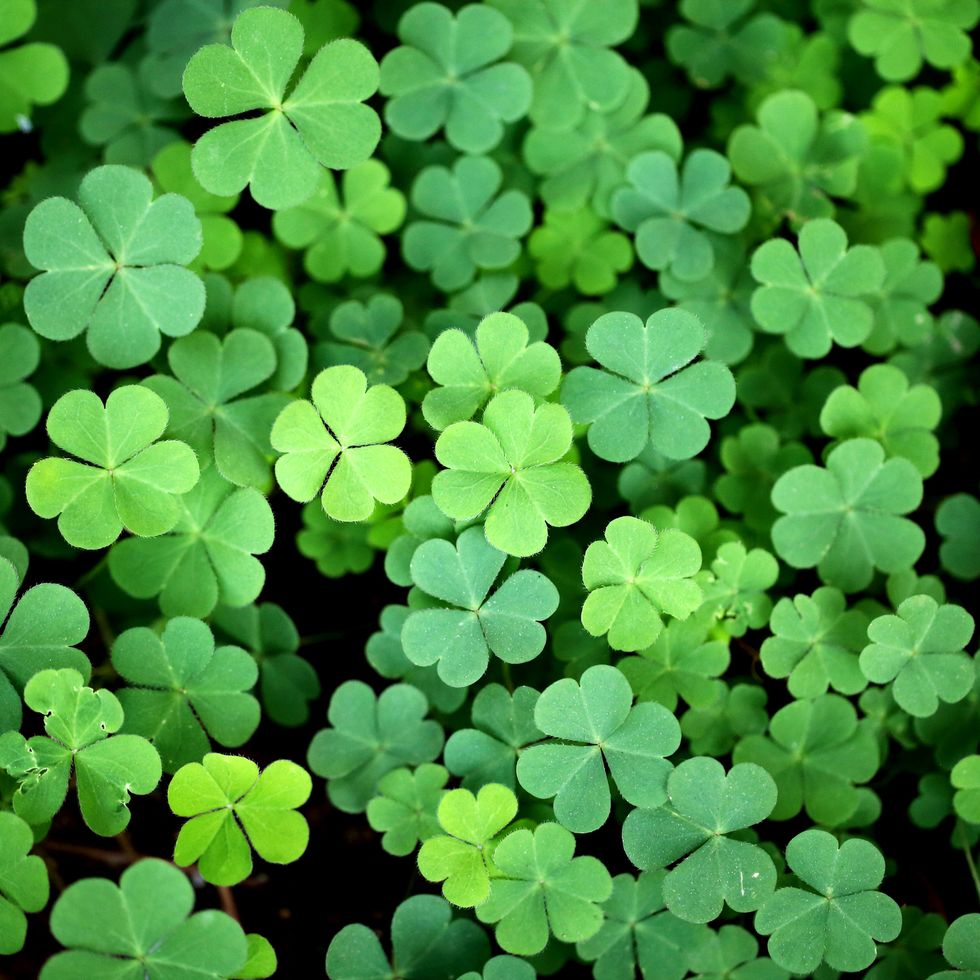
Shamrock vs. clover: what's the difference?
All shamrocks are clovers, but not all clovers are shamrocks. How can that be, you ask? Clover is the common name for plants of the genus Trifolium (from the Latin tres 'three' and folium 'leaf'), which is comprised of about 300 species. As you might guess from the name, clovers typically have three leaves. Occasionally, though, clovers will grow four leaves.
So, the shamrock symbol is a typical clover with three leaves. St. Patrick's Day shamrocks are usually green, but clovers can also be purple, green, or white.
Shamrocks have been the unofficial national flower of Ireland for centuries, according to TIME. The patron saint of Ireland, Saint Patrick, used the shamrock as a symbol to explain the Holy Trinity when he was converting the Irish to Christianity. Or so the legend goes. Either way, three-leaf clovers are plentiful in the emerald isle, and it eventually became common practice to wear them for the holiday.
Which is lucky: shamrock or clover?
While indistinguishable to most, shamrocks and four-leaf clovers actually aren't the same. Shamrocks have strong religious roots, while the four-leaf clover is prized for luck due to its exceeding rarity. In fact, around one out of 10,000 clovers have four leaves. Shamrocks also tend to grow in clusters, while a four-leaf clover is an unusual, one-off find.
Their meanings and symbolism differ, too. The shamrock is recognized as a representation of the Holy Trinity: the Father, the Son, and the Holy Spirit. On the other hand, the four leaves of a clover are said to stand for love, faith, hope, and luck. So if the goal is to spot both this St. Patrick's Day, the four-leaf clover is the one worth starting the hunt for now.
Do shamrocks only grow in Ireland?
While Irish folklore claims shamrocks to be so endemic to Ireland that they won't grow on foreign soil, the prominence of the plants most closely associated with the name "shamrock" outside of Ireland tells a different story.
Two of the most common clovers of the genus Trifolium are the white clover (Trifolium repens) and the suckling clover (Trifolium dubium). Both types of clovers are originally native to Europe but are also found in North America and even parts of Asia. So, while Ireland is famous for them, shamrocks grow in many places around the globe!

Micaela Bahn is a freelance editorial assistant and recent graduate from Carleton College, where she majored in English literature. She loves running, photography, and cooking the best new recipes.


